CREATE A DIFFERENT LOOK WITH THESE VINTAGE GEMS
Vintage lenses: not the expensive ‘wannahaves’, but affordable, worthy alternatives

Everything related to film photography is hot on Substack. Having shot more on film than digital, not in exposure numbers, but certainly in years, I must say, I find this somewhat surprising.
Reading what people post about the subject, I get the impression a lot of you love the nostalgia of film and the promise of creating beauty by ‘slowing down’, sometimes even denying digital photography any artistic value; I don’t read nearly as much about the difficulties of actually shooting film and the considerable effort that goes into being serious with film photography, not to mention the also considerable cost of filmstock. Those can certainly slow you down too!
I love film, its multitude of looks and its paraphernalia, so I do understand the involvement and interest very well. The world is rapidly becoming a digital chaos; film photography, maybe even every piece of analogue equipment in general, is an example of how beautifully simple the world used to be, not even that long ago.
Source: Image by PNGTree
The disappointment
Some of you get disappointed in your chosen dedication to film and pick up your smartphones and digital cams again, to revert to easier results and the instant gratification that you only get with digital (not counting Polaroid as an ‘easy’ means of getting results, I don’t think it is). Whatever you choose to photograph on or with, is fine by me, as long as you’re having fun doing it.
I do applaud the people on here though that persist in their film photography and really put in the time and effort and, as you can see in the photos they post, it obviously can be very rewarding. Some fine examples of this dedication can be seen in the work of JUSTIN , SOREN, BIRGITTE and RALPH, just to mention a few of the people I’ve had the pleasure to come into contact with so far.
So, what is this about?
I don’t think it’s really necessary though to tinker with a Paterson tank and dip your hands in very toxic chemicals to leave the realm of purely digital photography. This is both simple and affordable and doesn’t include the hassle of developing (and printing) in a darkroom, or even handling film. Using vintage lenses can add an ‘analogue feel’ to your digital photography, not unlike the film sims on your Fuji can (check out SARAH ‘s work), but with lenses, made many years ago, made out of glass and metal (and sometimes a tiny bit of plastic or rubber).
A lot of (Hollywood) movies nowadays are shot digitally, but with vintage lenses, because of the unique look they lend to the cinematography. Cinema lenses were always focused manually anyway, and a vintage lens is relatively cheap and has ‘character’, which is actually a euphemism for having flaws, but the type of flaws we think of the same way as the ones we see in human beings we look at with love.
YouTube videos and real info on vintage lenses
But, before you start exploring the internet for great vintage lenses, a warning: please don’t fall into the trap of the ‘best’ vintage lenses being the most interesting for you. Ask yourself: the best in what respect? Resolution, color separation, rounded bokeh, contrast, crazy swirling effects? You have to know a little more than ‘this is the best’, because you might be after something else than the next photographer.
Vintage lenses have become really popular since the introduction of mirrorless cameras, because of the amount of control over focusing and the preview option that these cameras offer. It’s just because vintage lenses are so sought after, that the usual YouTube rats out for a piece of the pie are everywhere, giving utterly useless ‘advice’. I’ve seen lots of very young men (rarely women) ‘having tested lots of vintage lenses’, and the outcome is almost always the same: their favorites are the Takumar 50 mm 1.4 (Japan’s answer to German lens hegemony), the KMZ Helios 44-2 58 mm 2.0 (earlier versions, ‘not Valdai’, as if they really tried different copies), the Nikkor 105 mm 2.5 (the ‘Afghan girl’ lens), and the Carl Zeiss Jena Pancolar 50 mm 1.8 (for the very nerdy, ‘almost equal’ in quality to the best Leitz lenses). There are more, but these keep popping up all the time.
Don’t get me wrong: these are all good lenses and I wouldn’t keep you from buying any of them, but there is a problem with all this praise: these lenses have become quite expensive, as their renewed fame has boosted their market value. The Helios is the most obvious example of this phenomenon: it used to be dirt cheap (<20 dollars or 15 euros), but a ‘near mint’ copy of the Helios 44-2 made by KMZ will now easily cost you 100 to 200 dollars, and that’s only the cheapest of the ones I mentioned. There are first-rate alternatives for each of these lenses! I will mention only lenses I know and used extensively myself. In this post, I’ll limit myself to ‘standard lenses’, with focal lengths between 50 and 60 mms.
The four lenses I have used here
These are the four lenses I used to create the sample shots you see below; affordable ones I recommend, with image examples. You can get any of these lenses in good or even excellent condition for less than 50 dollars/euros. Look for yourself. As you can see, there are some clear differences. But remember, these are my copies of these lenses, and vintage lenses might show variations between copies. All examples were made with identical exposures and at set different apertures, on a full frame (Canon EOS R 6) mirrorless camera. I converted all photos to B&W, so you can concentrate more on essential differences, like contrast, ‘bokeh’ and resolution. The differences in color rendition are very small anyway.
You can see multiple photos I made with some of these lenses in my Substack notes.
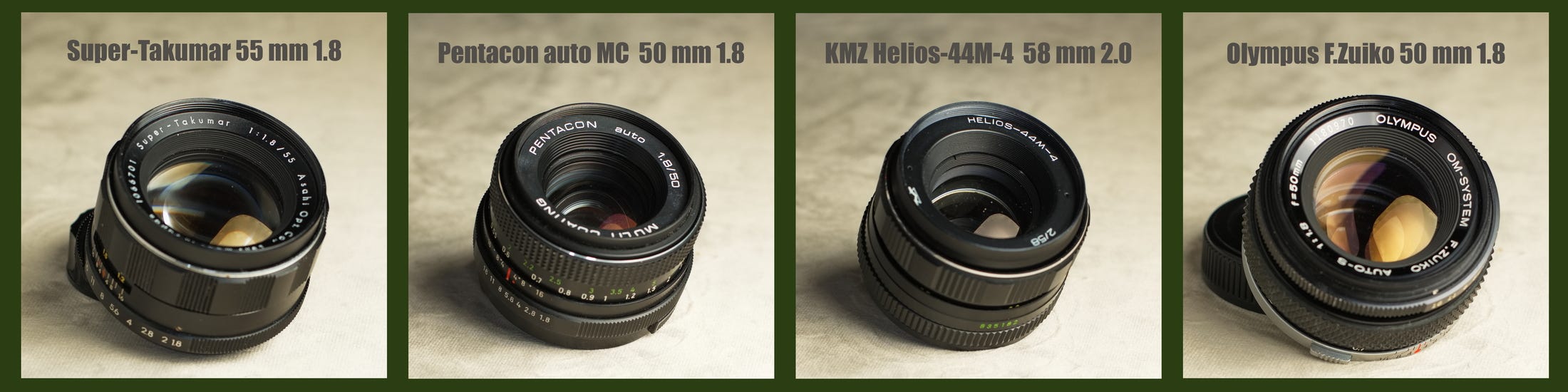
Super-Takumar 55 mm 1.8 (or 2.0, these are the same in performance and character)
Pentacon 50 mm 1.8 (the same as Meyer Oreston 50 mm 1.8, multi-coated version)
Helios 44-M-4 58mm 2.0 (a less ‘swirly’, but much cheaper version of the Helios 44-2)
Olympus Zuiko 50 mm 1.8 (In numerous versions, but I haven’t seen big differences)
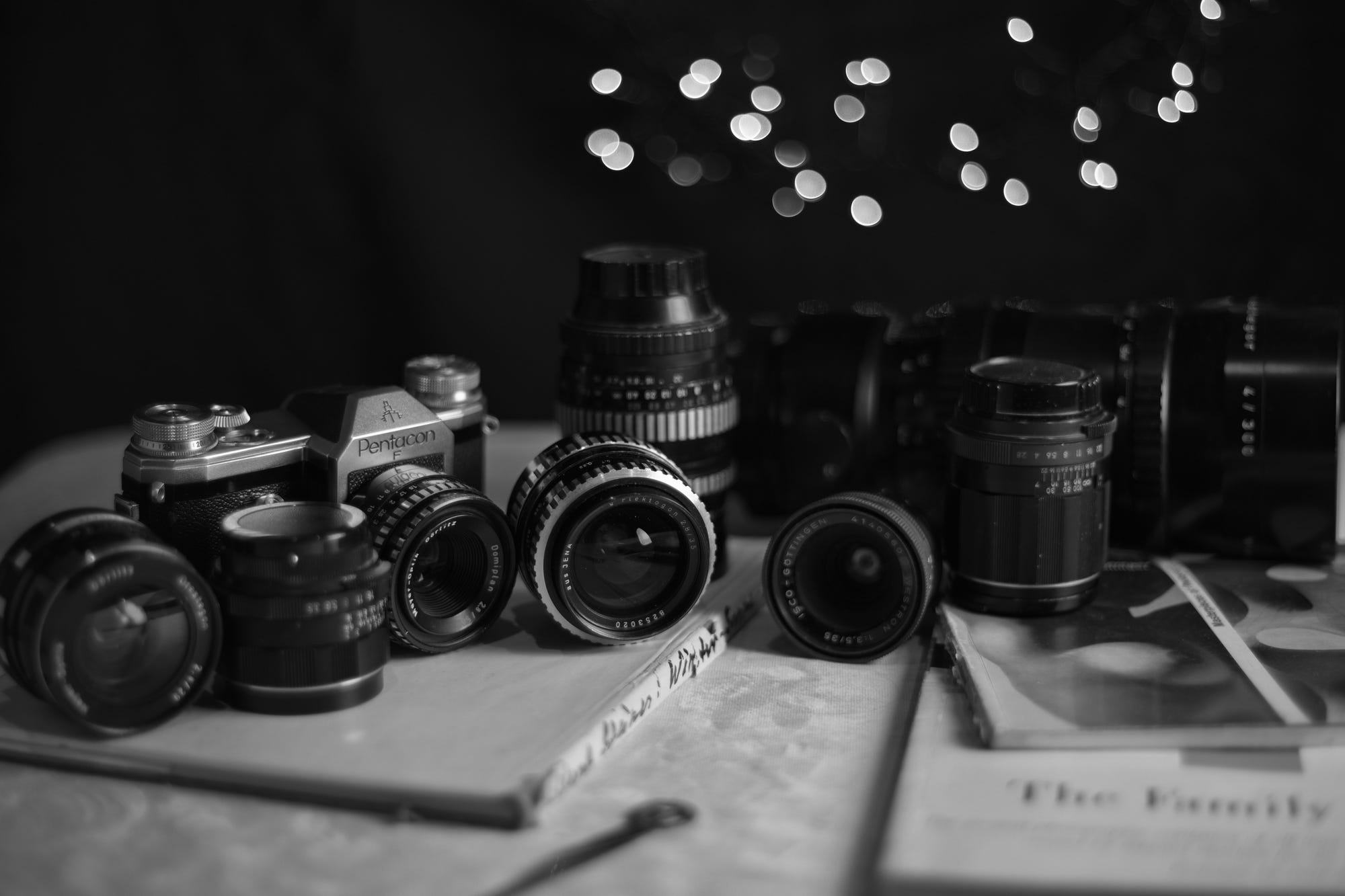
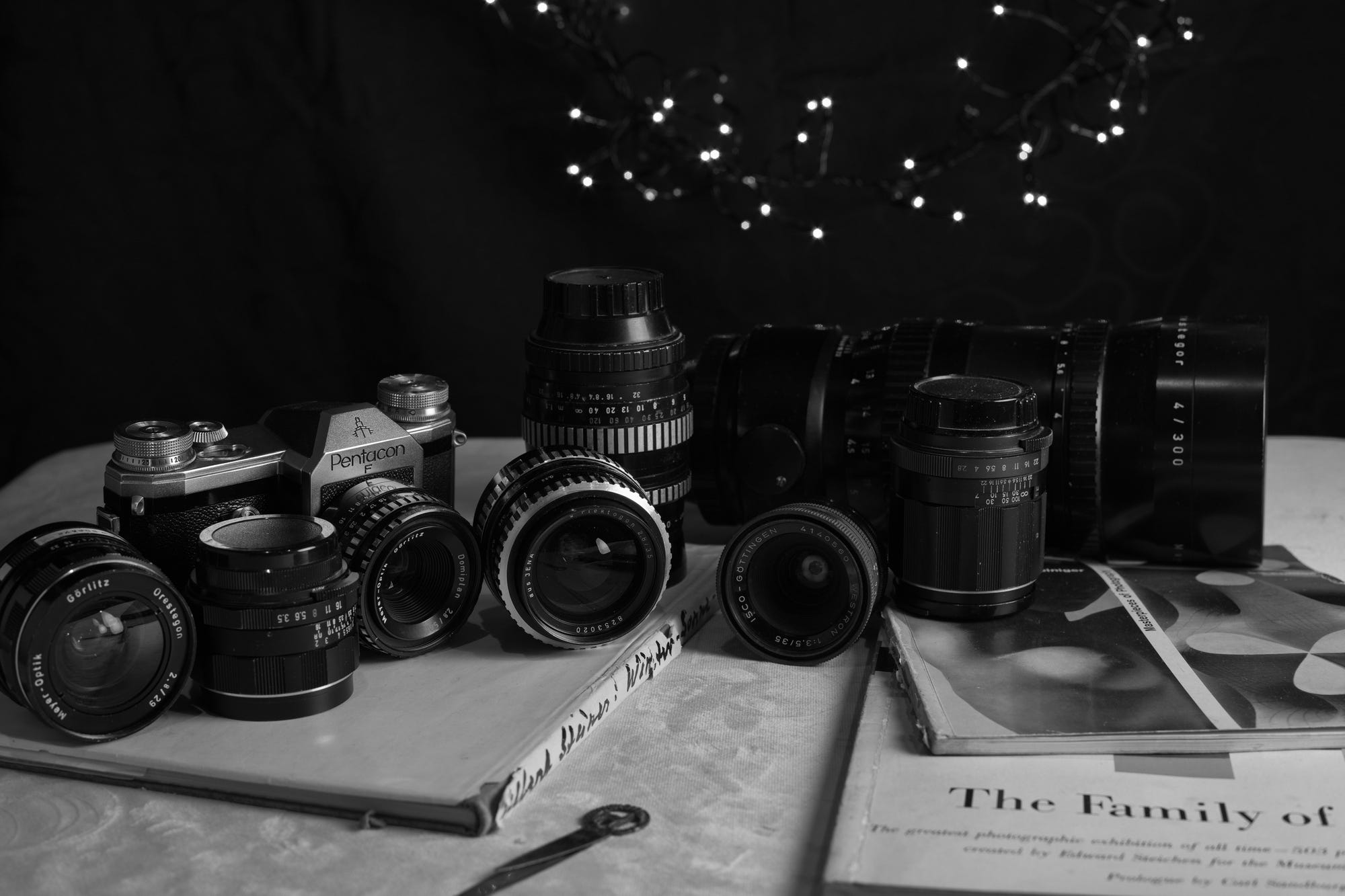
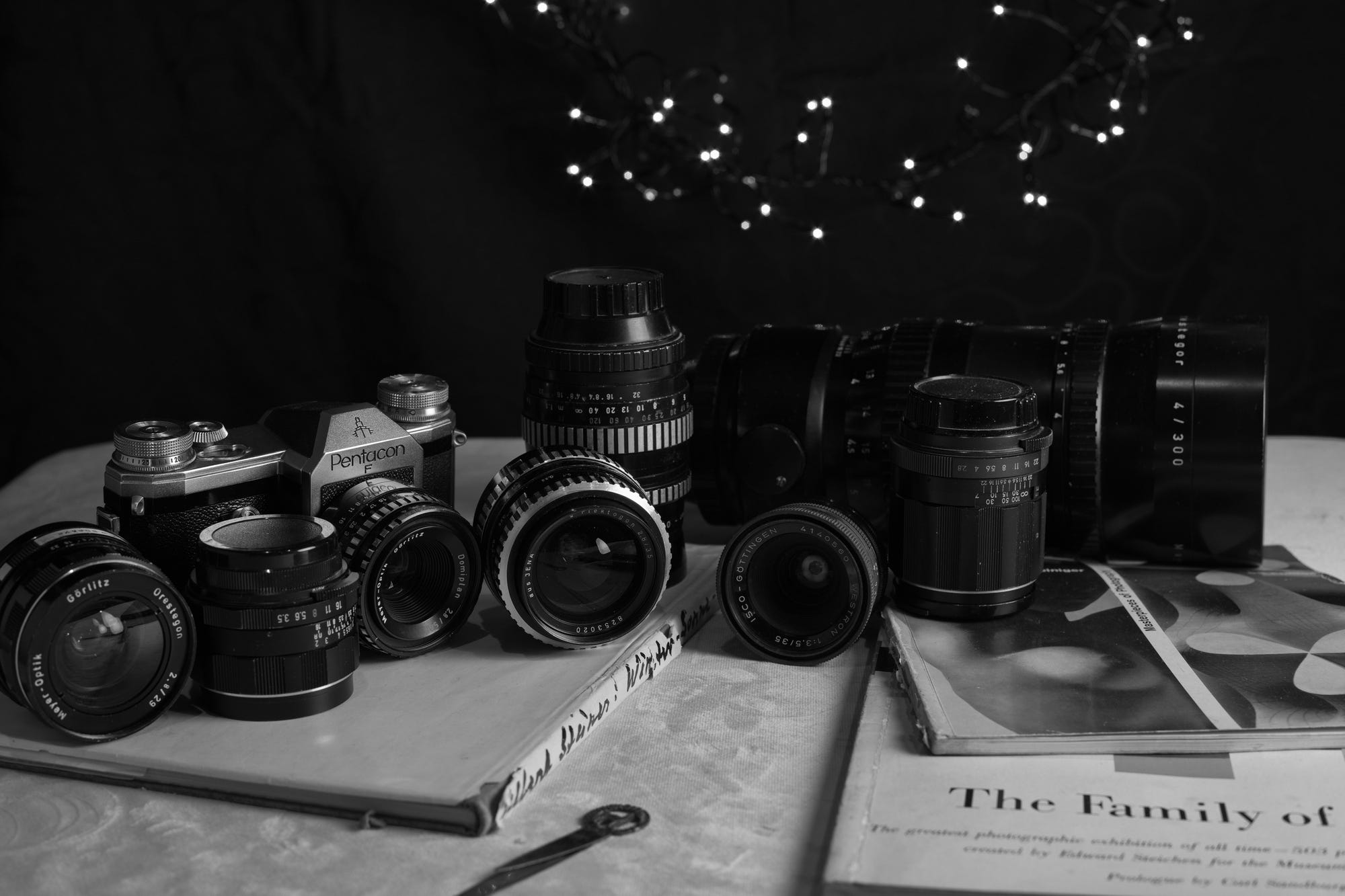
To give you some insight in how these four lenses perform on a (full frame) digital camera, I have made three series, based on different apertures for these lenses. My apologies for the nerdy ‘60s-‘70s subject matter and the Christmas lights in the background, but those help to make the comparison easier. I shall refrain from commenting in this post on the differences I see between these examples myself, maybe I’ll write about that in another post. To those of you (nerds) who would like to know more about the lenses in the image, let me know and I’ll tell you all about them.
with fully opened aperture, f1.8 (or 2.0 for the Helios)
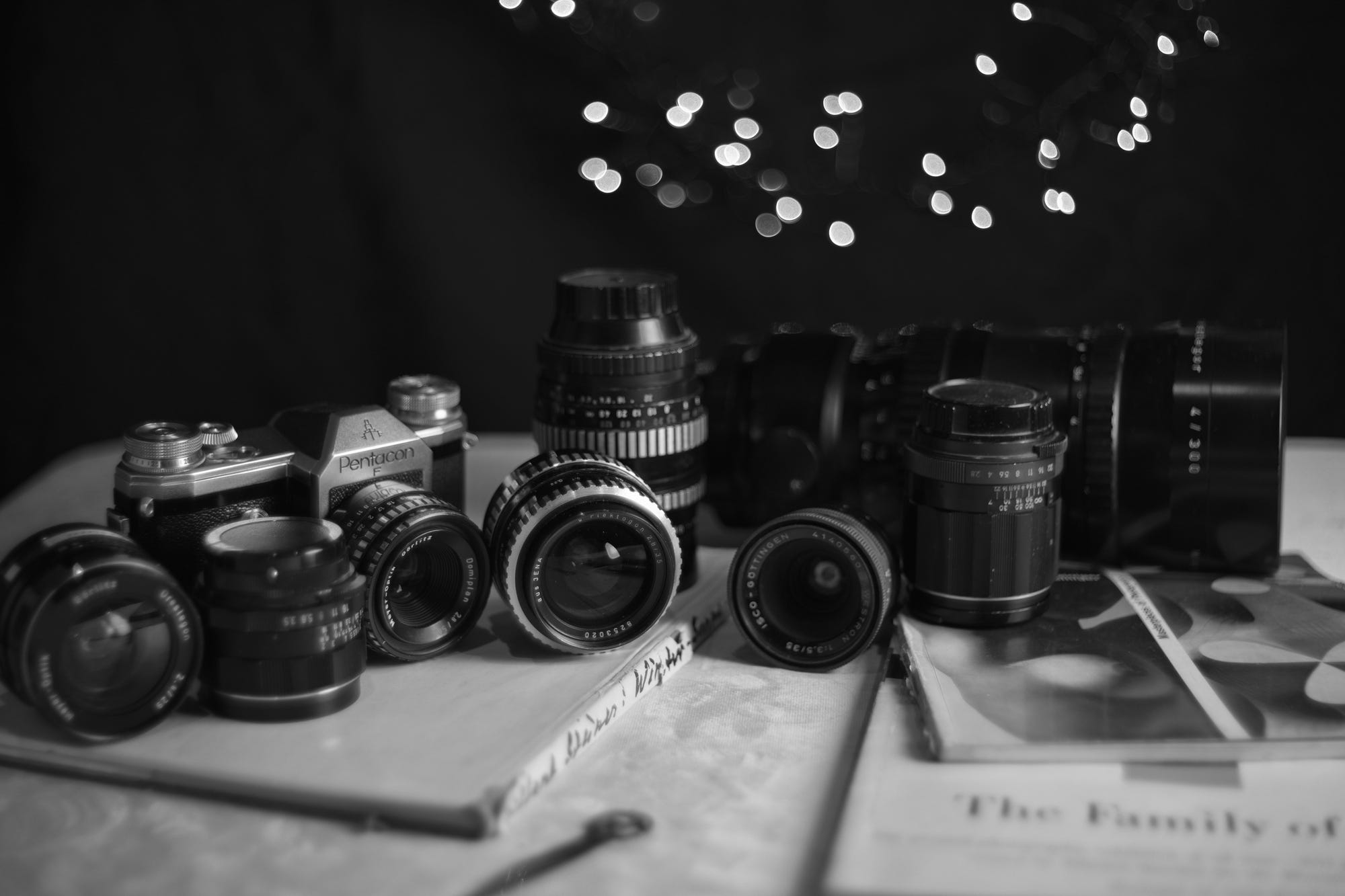
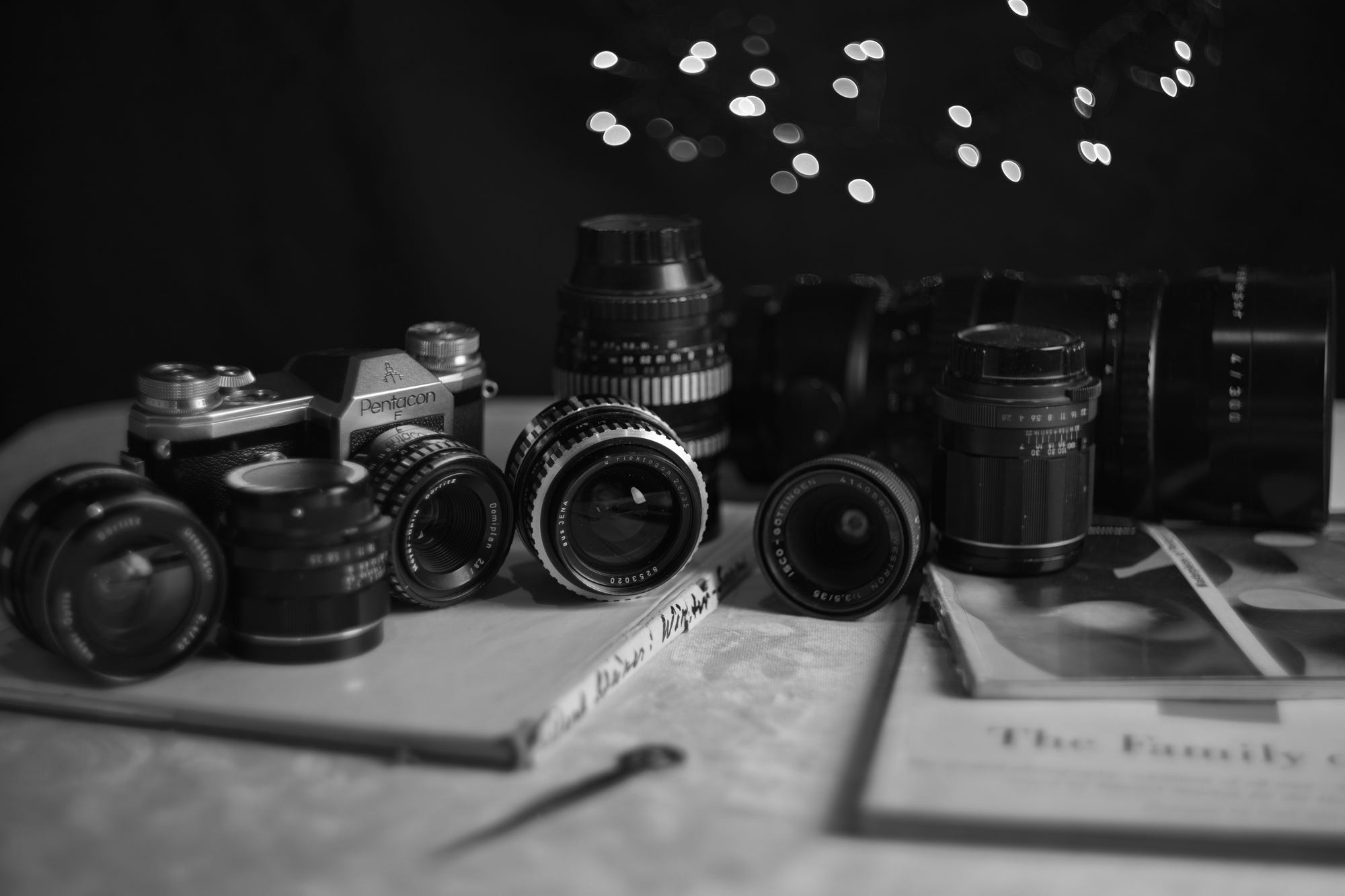
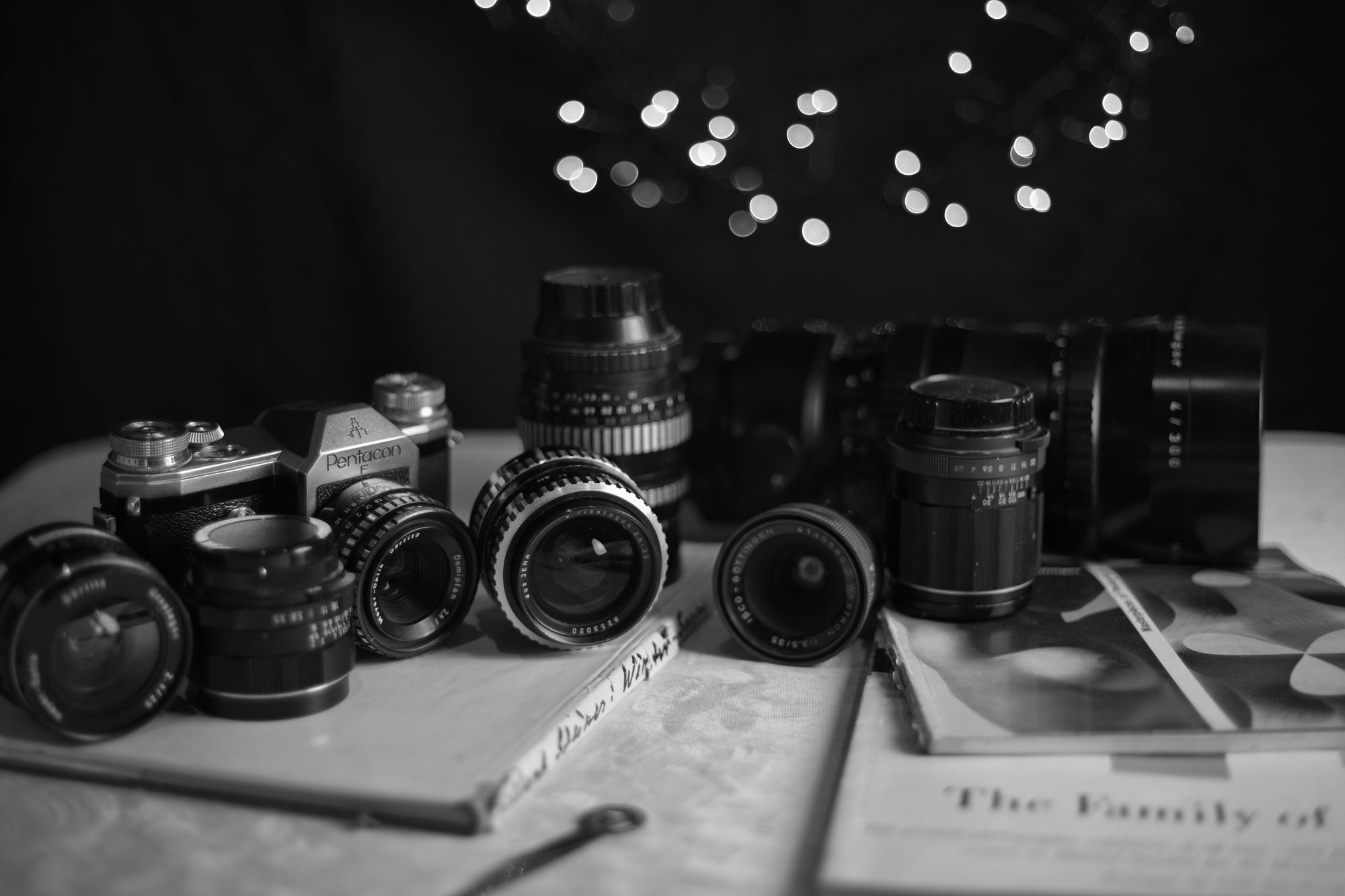
Stopped down to f 4.0
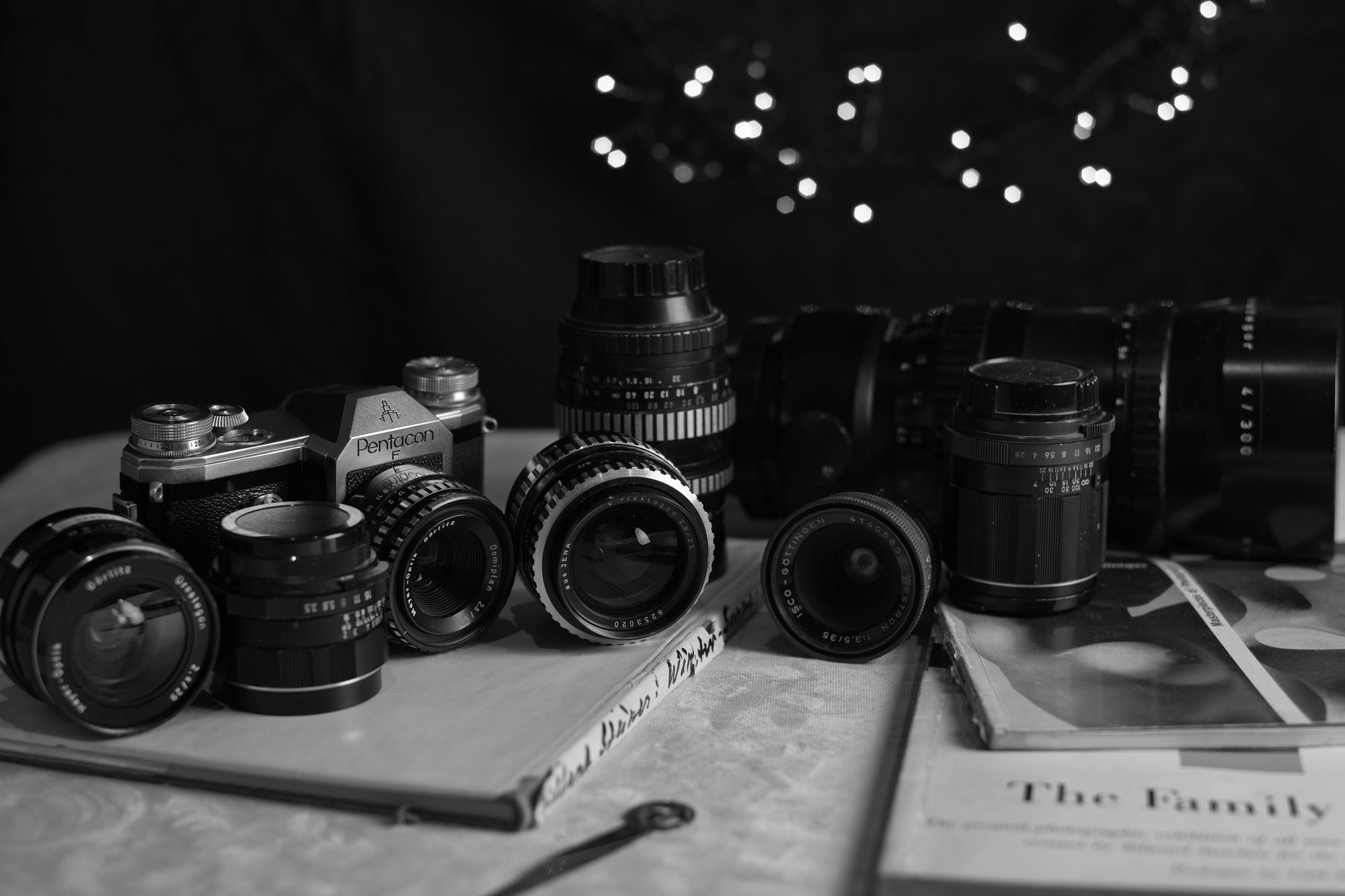
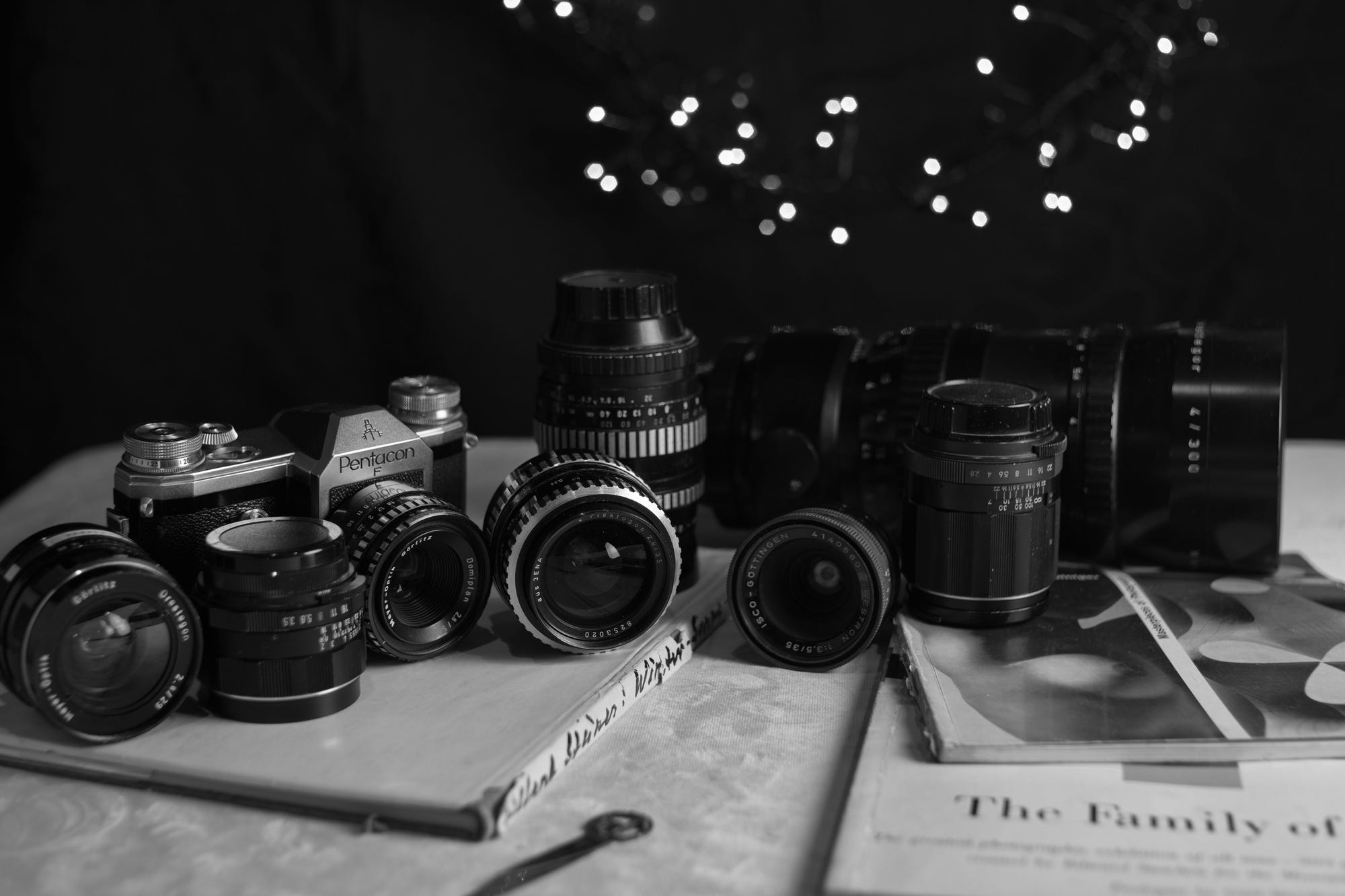
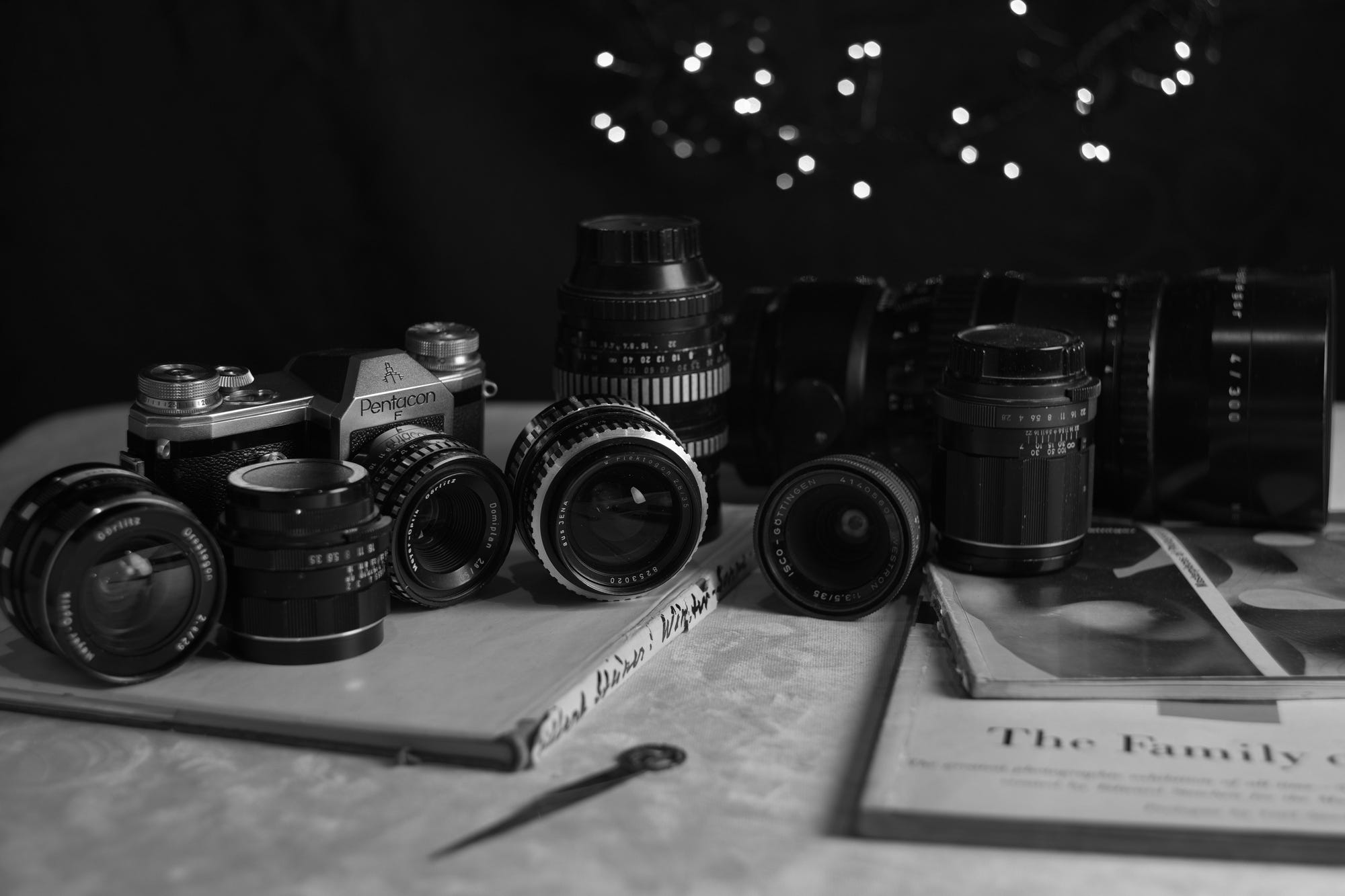
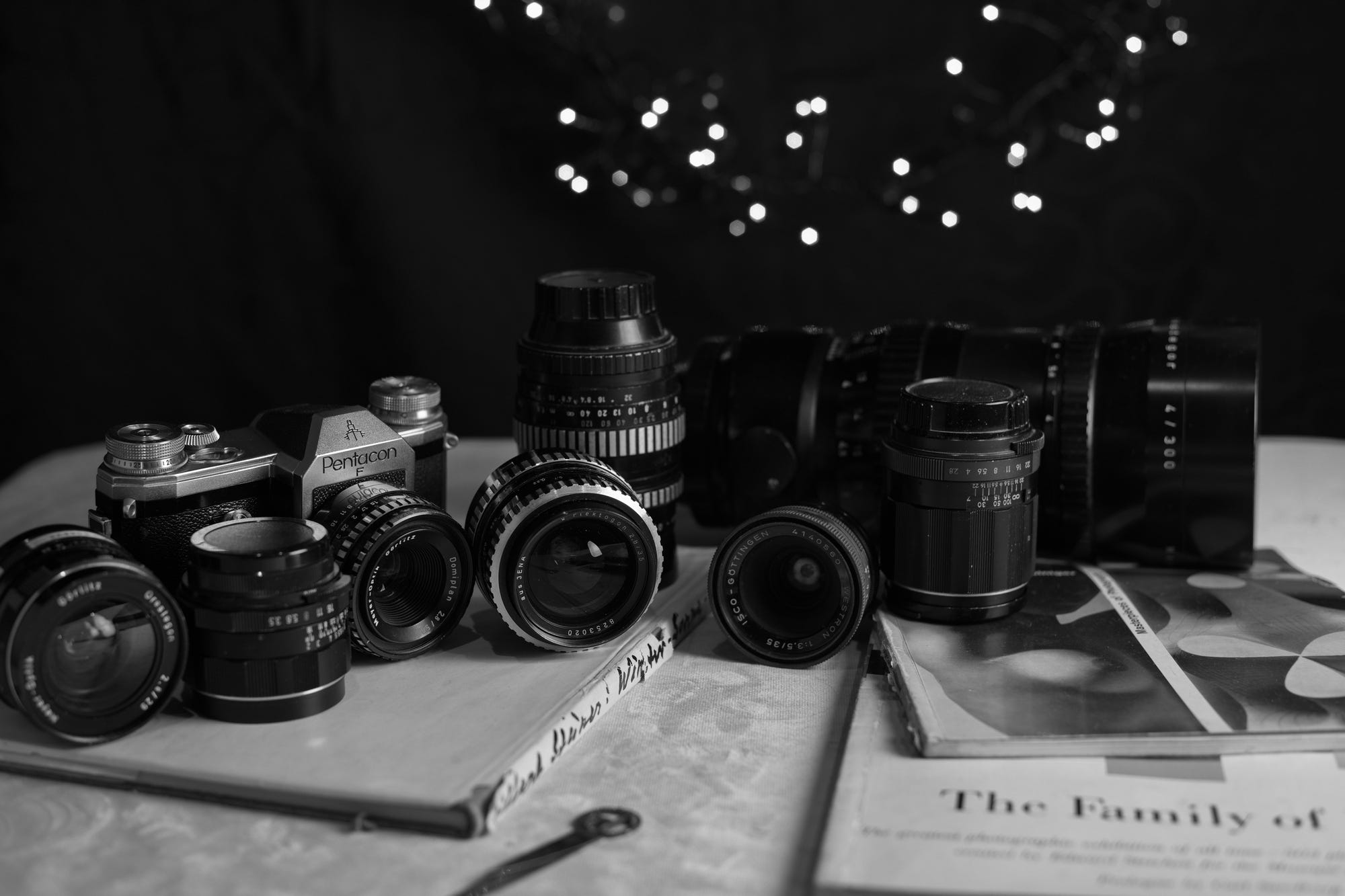
Stopped down to f 8.0
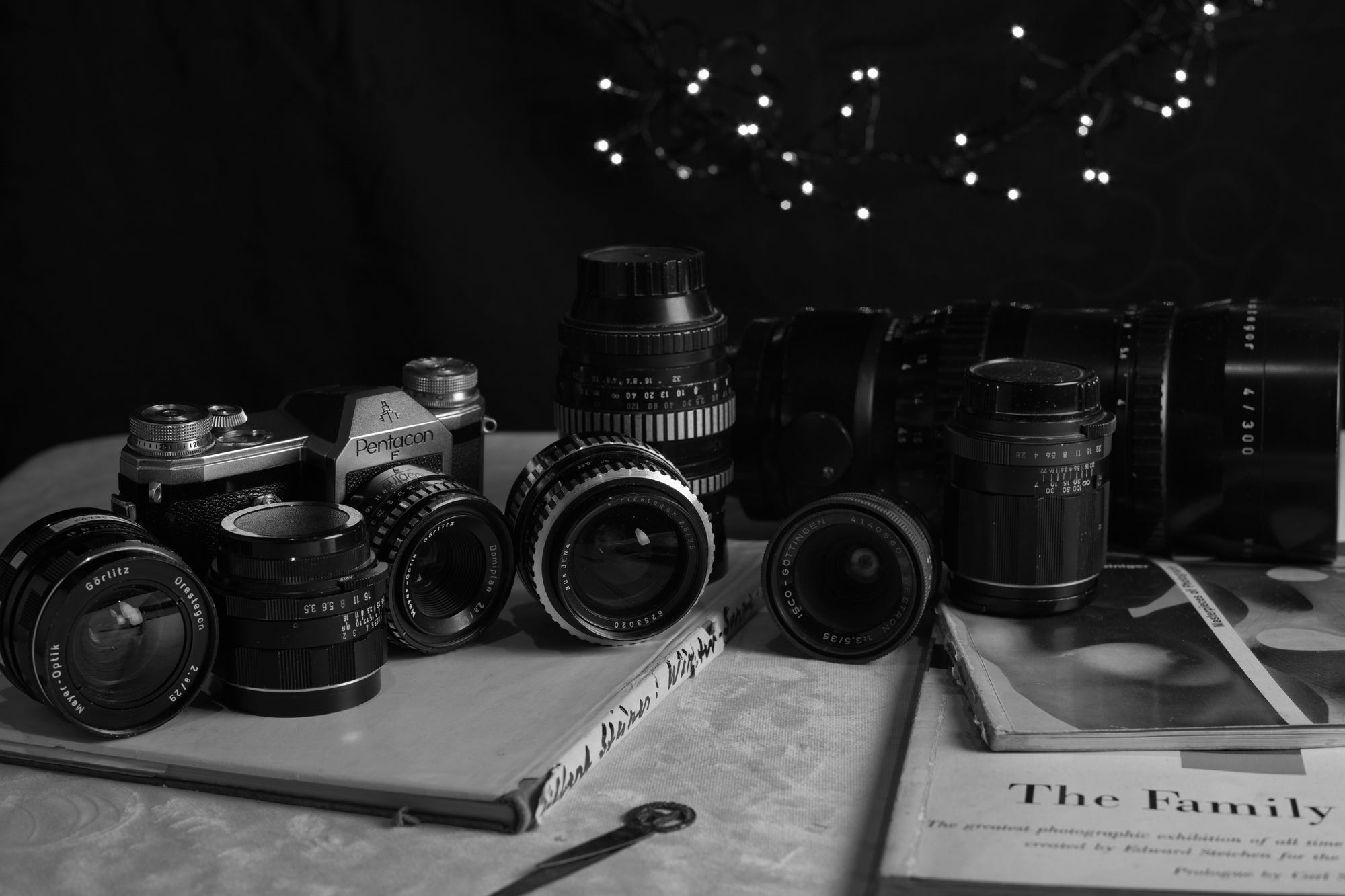
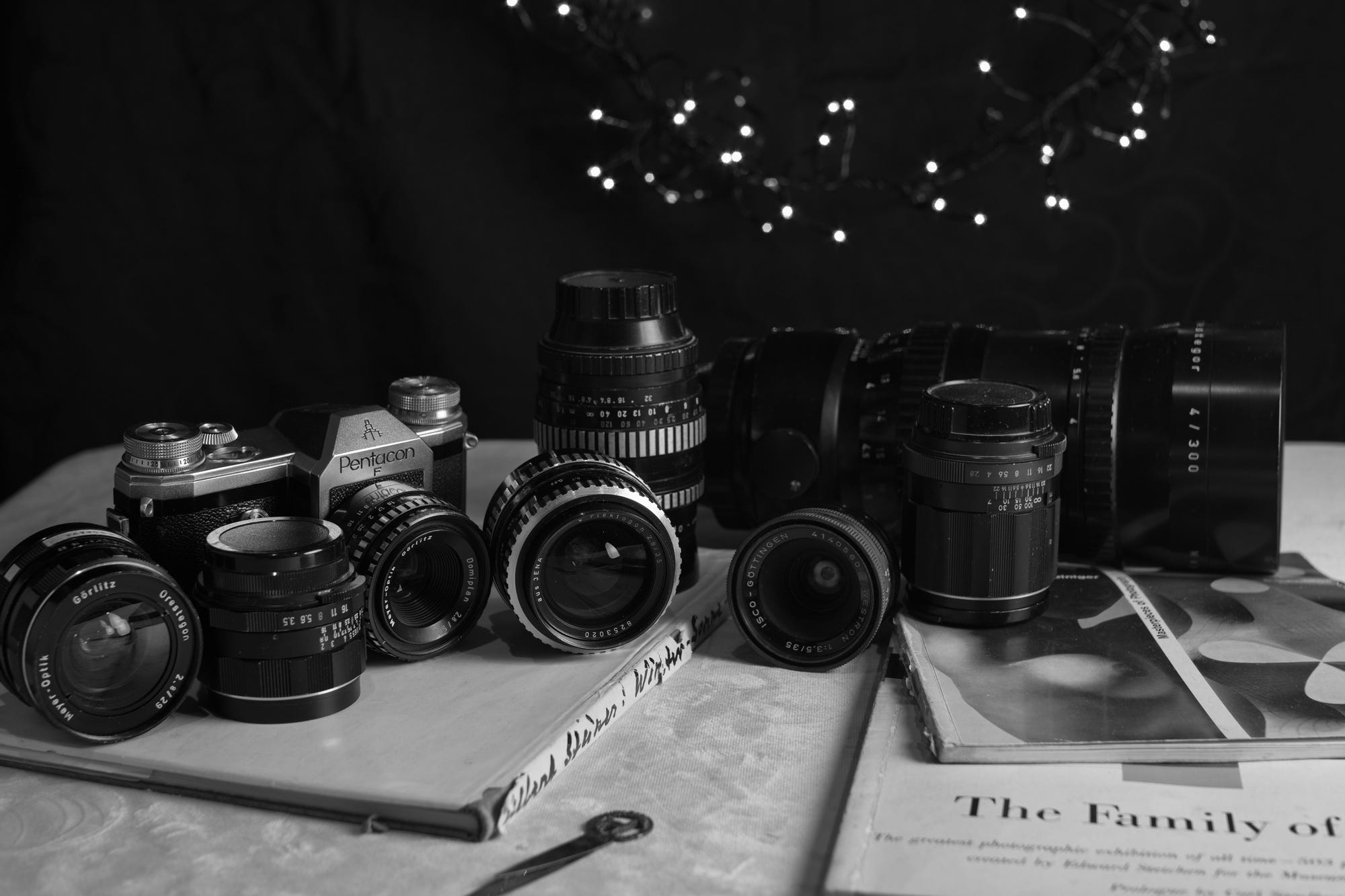
Using vintage lenses on digital cameras: things to consider
In order to use vintage lenses on your digital camera, you need an adapter that will make the mount of the lens fit onto your camera mount. In most cases, a relatively cheap adapter will do, but one with a tight fit from a respectable adapter brand sometimes works better than the cheapest options. If you’re serious about trying this, expect to spend (on average) anywhere from 10 up to 70 dollars (or euros) on an adapter. Check user reviews!
Starting out with vintage lenses, there’s a few things to consider and/or might take some getting used to:
1. Vintage lenses (with only a few exceptions) don’t have AF (auto focus). You’ll have to adjust focus manually, but this is fun and makes you think more about where you want the focus to be (and how much depth of field you want). Be careful with Aperture Priority on your camera; sometimes it doesn’t work reliably, always check your exposure anyway. Manual focus assist (different techniques in different camera brands), most of all, focus peaking (showing the area that’s in focus highlighted) works very well.
2. Vintage lenses may have issues: due to their age and possibly bad handling, they might have scratched glass, dust, or worse, fungus, dried out lubricants and sticky (oily) aperture blades, just to name the most common issues. The good news is that most of these can be fixed, but fungus that has really settled deeply might not be. If you want to steer clear from these problems, test your purchase, or at least ask for very clear photos before buying. If a lens is really cheap, you can take the risk. You’ll easily sell it for the same price you bought it, or you can gift it to someone else who might have fun with it.
3. Buy lenses with a common mount; there is enormous choice in lenses with screw mount (M42), Canon FD, Nikon F and Olympus OM, and adapters for these mounts tend to be cheap but decent.
4. Manufacturing procedures have evolved and modern lenses often hardly show discernable differences between copies, but that is not the case with vintage lenses: some copies are different from others. Avoiding this altogether requires careful study of serial numbers and batches. In lenses of the well-known brands, these varieties are not so huge (they often had quality control in their methods and stages of manufacturing and have ‘passed’ stickers on them if they were up to standard).
5. The focal lengths you typically will find mostly are 28 or 35 mm (wide angle), 50 or 55 (58 on Helios) mm (standard) and 100/105 (~macro) and 135 mm (light tele). Other focal lengths are more rare. 200, 300, 400 mm or more can be beautiful, but most of them are not very suited for e.g. sports or wildlife photography (no AF, weighty metal construction), maybe more for landscape photography or portraits. All of these focal lengths correspond with ‘full frame’ standards, on crop sensor cameras, the effective viewing angle is narrowed (1,5 x on Nikon & Sony, 1,6 x on Canon, 2 x on Micro Four Thirds Panasonic/OM System). The focal lengths themselves of course will not change, but what your ‘crop sensor’ sees, is only a part of the image coming through the lens. This sounds like a disadvantage, but in macro and tele it’s a plus, because the subject will appear enlarged. Also, as crop sensors typically see only the center part of the projected image, there’s sharpness across without distortion or light fall-off in corners. Quality differences between lenses are ‘enlarged’ as well, so be critical in your evaluation of the results. Be fully aware of the consequences when you make your choice.
6. Multi-coating is standard in modern lenses. It mainly prevents various less favorable effects that might occur when dealing with light falling into a lens from certain angles, or when photographing straight against the light. Older lenses have less developed versions of multi-coating, or even none at all, making them prone to flare, from mild to extreme. The only thing that will help against this, is using a lens hood (or shielding the lens with one hand while holding the camera). Some people like flare, as it may support a photo’s mood, but in most situations, it is not ‘good news’, it lowers the contrast of your image considerably.
7. These lenses are a sound investment: they are the summit of manufacturing of the mechanical era: made of glass and metal, and moving parts built to last. The lenses I present here are all at least 40 years old and still going strong. Will your super-sharp, computer-designed lens with image stabilization and lightning-fast AF still be around and usable in 25 years? I somehow doubt that.
How to select and where to look for vintage lenses?
Start your search by looking at images made with the lens you’ve heard about/you’re interested in. On a site like Flickr you can often find lots of examples, but look especially for/at the ones made with a camera similar to yours.
There are lots of test sites, forums and specialty sites dedicated to vintage lenses, which offer much more relevant info than most YouTube channels.
E-bay is of course a good place where you might find any vintage lens, but checking markets and fairs or collector’s events often lead to better finds, with the great advantage of being able to check a lens yourself. Check the moving parts (the focus and aperture rings), hold them against a light source to check for dust and fungus. At these places. you’ll also meet people who have a lot of relevant knowledge. Be on the look-out for worn out cameras with lenses attached; these lenses may still be good, and even cheaper than the ones sold separately. You can always gift the broken camera to someone who fixes them as a hobby (or these days, an extra source of income).
This (very long, I know) post is about old photographic equipment, but also about the joy of using old glass and getting likeable or even incredible results. Lenses are to creative photographers what brushes are to painters. I would like to encourage you to try vintage lenses and posting your own photos.
I really like to know how you interpret the differences between these lenses, so don’t hesitate to write it in a reply or in your note or post. Did I leave something important out? Do you disagree? Let me know!
Want to see more posts like this one? Subscribe and get them delivered to your mailbox!
An interesting read, Vincent. I've used film since the age of 13 (1974) and, although 90% of the photos I take these days are digital, I won't be without 35mm and 120 film cameras. I've used numerous systems in the last 5 decades. The first good camera I had was an Olympus OM1. Life goes full circle as I recently reacquired an OM1n. As for 120, I used Hasselblad for many years (+ Mamiya and Yashica) but, these days, I have a Rolleiflex 3.5T. I have a few legacy lenses I use with my Fuji XF bodies and Leica SL2. A favourite is my Zuiko 50mm f1.4 'silver nose'. Soft wide open but sharp as a tack beyond f4. My 50mm Leica Summicron-R is also a great lens but, IMO, lacks character in comparison to the Zuiko. I'd have been happy if digital had never been invented but, as it has (and I'm not getting any younger), I'm happy experimenting with what I have to hand.
Dear Vincent, first of all thank you so much for mentioning me! I have to be honest I never even thought of or considered vintage lenses for my digital camera, but they are indeed a great option for photographers who find film a bit frustrating or too expensive. Or why not - just to play around. I am actually surprised that the lenses aren't more expensive (even with the popularity increase in prices). I am however one of those persons who find it very hard to return to digital photography. I definitely still consider digital photography art, but for me it is the whole process which no longer gives me any satisfaction. I love the waiting time, which is necessary when you shoot film, I love the surprises, when I get a roll back from the lab, and I had forgotten what was on it, of course I love the look of film, and then I have to admit that I LOVE the fact, that I don't have to post process my photos on the computer.