Rome, without smartphones
A black and white photo travelogue from the '80s

Form and substance
Form and substance is a newsletter dedicated to various art forms, but first and foremost photography, my go-to way to create in an easily shareable form. By describing the process(es) behind and thoughts about anything posted here, I want to inspire others to create and share. Art and beauty rely on the inseparable connection between what you see, hear, read and the value it conveys to you, in short: form and substance.
The photos and stories I share here are from over 40 years ago, when I had been into photography for only a few years. For some time now I’ve been rediscovering my negatives from this period and have begun to make some of them presentable digitally. There were nasty scratches on the negatives and exposures were often far from ideal, but seeing your own photos from decades ago is sufficiently satisfactory to compensate for the effort that goes into it.
The photos I have included here are part of my first real ‘photography project’, a kind of travelogue. A short background to this: I was a student in the history of art in Utrecht and I could go on a study trip to the ‘eternal city’, Rome. That was of course an important part of my art historical education; it also seemed like a great opportunity to get more experienced in different genres of photography (street, art & architecture and personal encounters was what I envisioned). When I got on a train to Rome on June 1st, 1984, I was carrying one camera, one lens and six rolls of B&W film. Not much to take with you on a trip to a metropole, but it simply was all I could afford at the time. In the early ‘80s we were all still frugal with a roll of film, as we should be again nowadays, considering the prices of film.
Not knowing exactly what you’ll want to shoot once you get to your destination is limiting to say the least; I had to ask myself constantly if something was really photo-worthy, but luckily it didn’t hold me back too much. My enthusiasm about the world I just entered always got the upper hand, I guess.
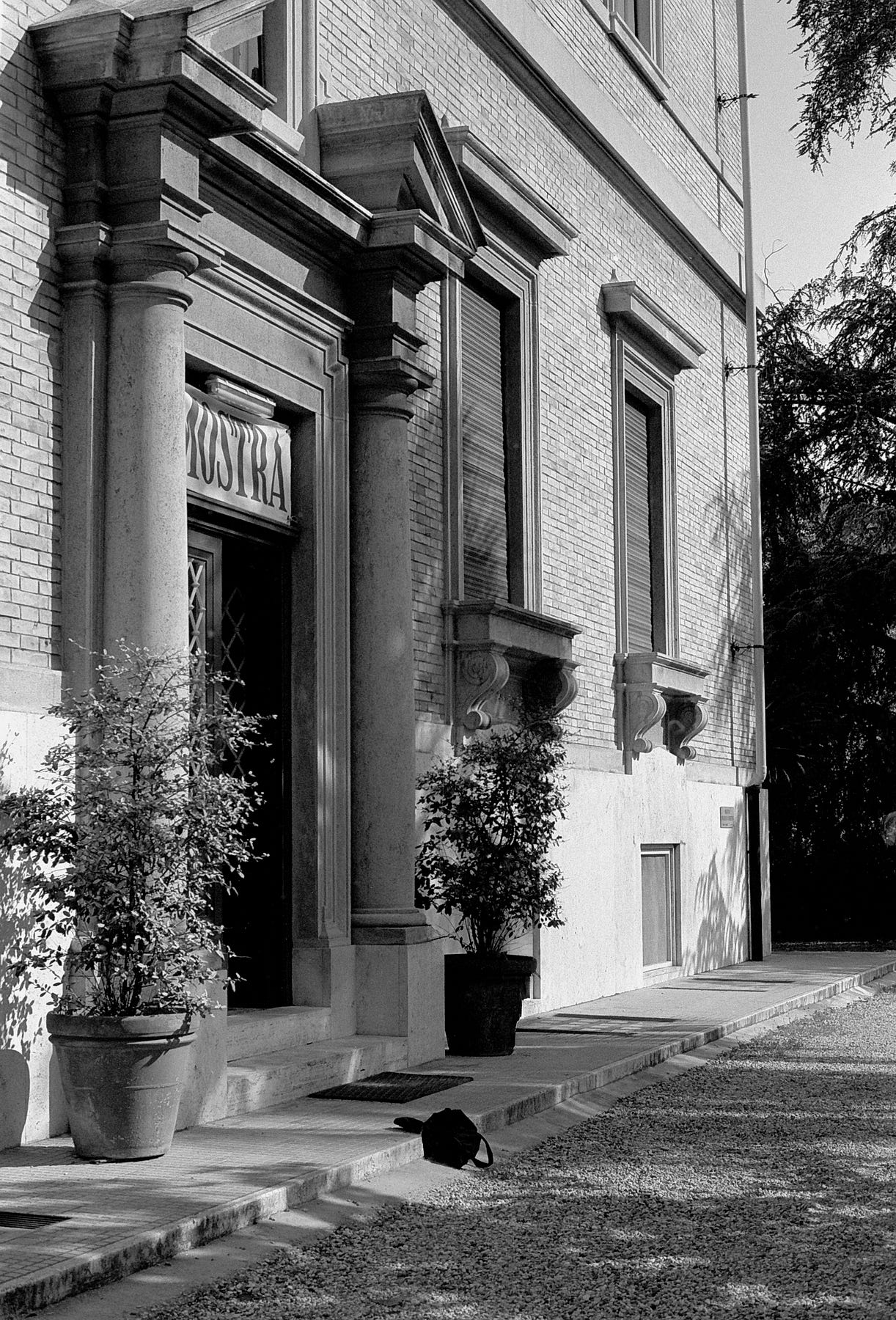
Our small group of students was housed in a large stylish building, the ‘Istituto Olandese’ (Dutch institute), which way exceeded our expectations. It was more luxurious than what any of us were used to and had a beautiful garden, a giant balcony looking out on it, a big kitchen, a library and a music room with two grand pianos. The photo here was one of my first on this trip, the sun was already hot at 08:30 AM and shone at the entrance of the building when a group of students got ready to explore the city. I wanted to move the bag for the shot, but one of my fellow students suggested to leave it in sight and make the photo into a memento of our presence there, which I did. That seemed like a big decision at the time; nowadays most people wouldn’t even bother considering such a choice, as anything we don’t want to be in the picture can be easily edited out afterwards. The banner indicates there was also some exhibition going on, but we never saw any visitor when we were around.
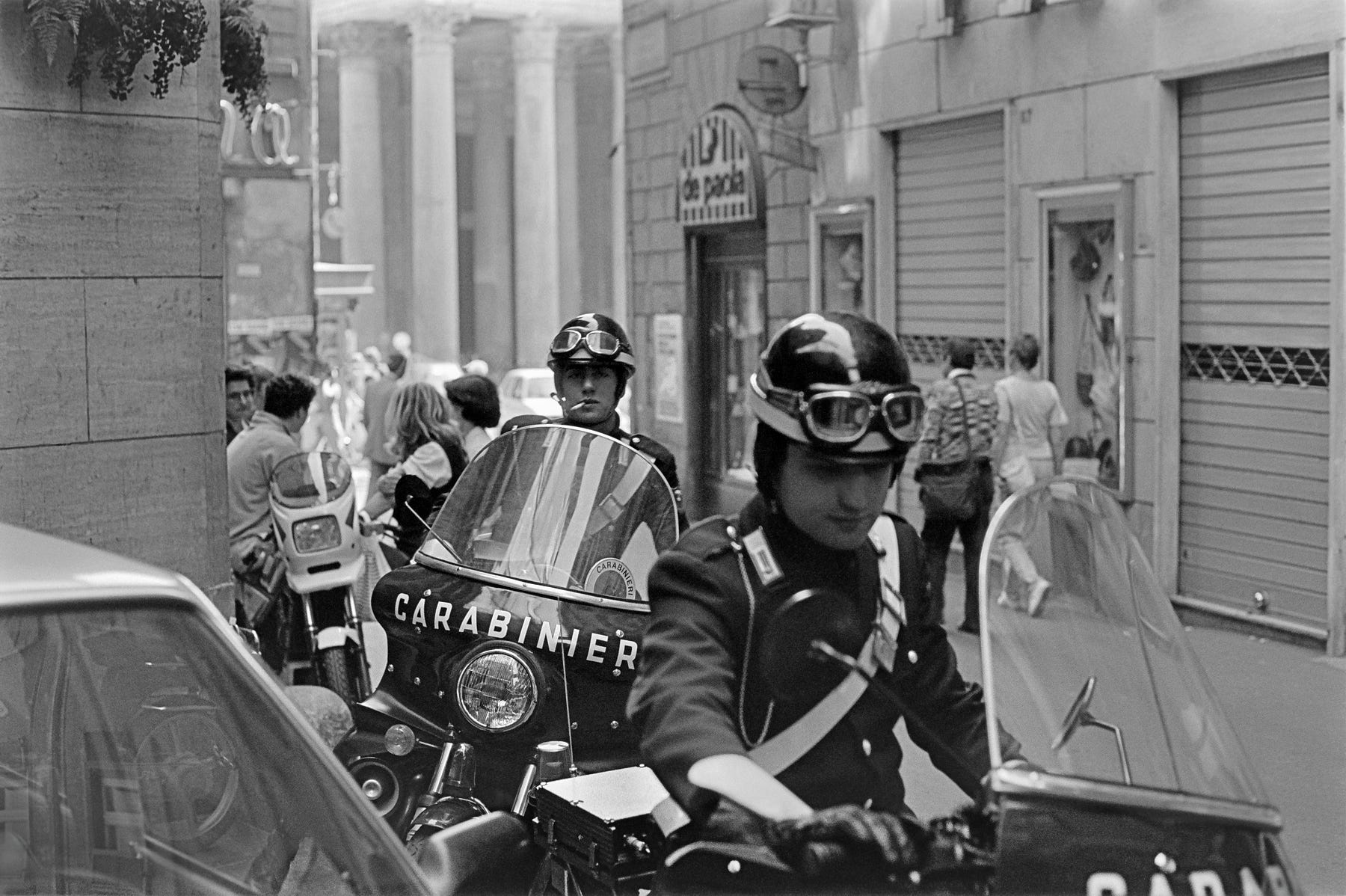
On my first full day in Rome, I encountered two ‘carabinieri’ policemen on their bikes, stopping for a smoke, something I had never seen before. They posed willingly, especially the one further away from me, with the cigarette still in the corner of his mouth, while they were being called to duty. That also meant I could have only one quick go at this; I enjoy the way it all came together in this one shot all the more. The policeman’s ‘tough guy’ bravado is obvious, and he took pride in it. In the background you can see the Pantheon, bathing in bright sunlight, but also a group of people hanging out and a (tourist) couple passing by. The negative of this photo was badly damaged (and slightly underexposed), so I’m glad to have a digital version now.
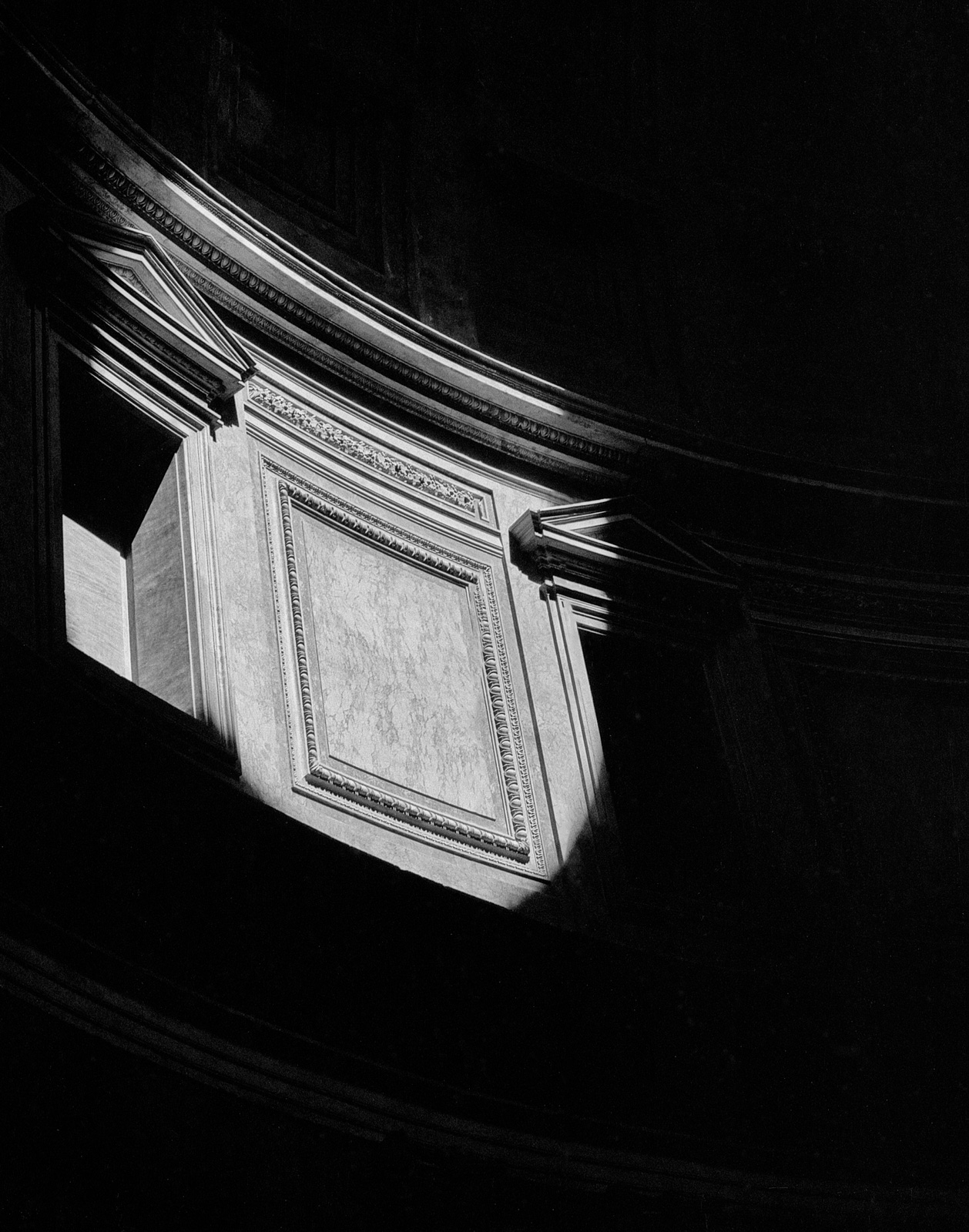
The Pantheon’s classical architectural style and sheer size are impressive, but what struck me most about it was the sunlight falling through the roof, lighting up a detail of the interior like a spotlight. I felt somehow privileged to witness this quiet scene in the hustle and bustle of the city surrounding it, hearing the traffic noise outside while looking at architectural ornaments made roughly two millennia before. I had time to make this photo, so I concentrated on getting the exposure right for what I had in mind.
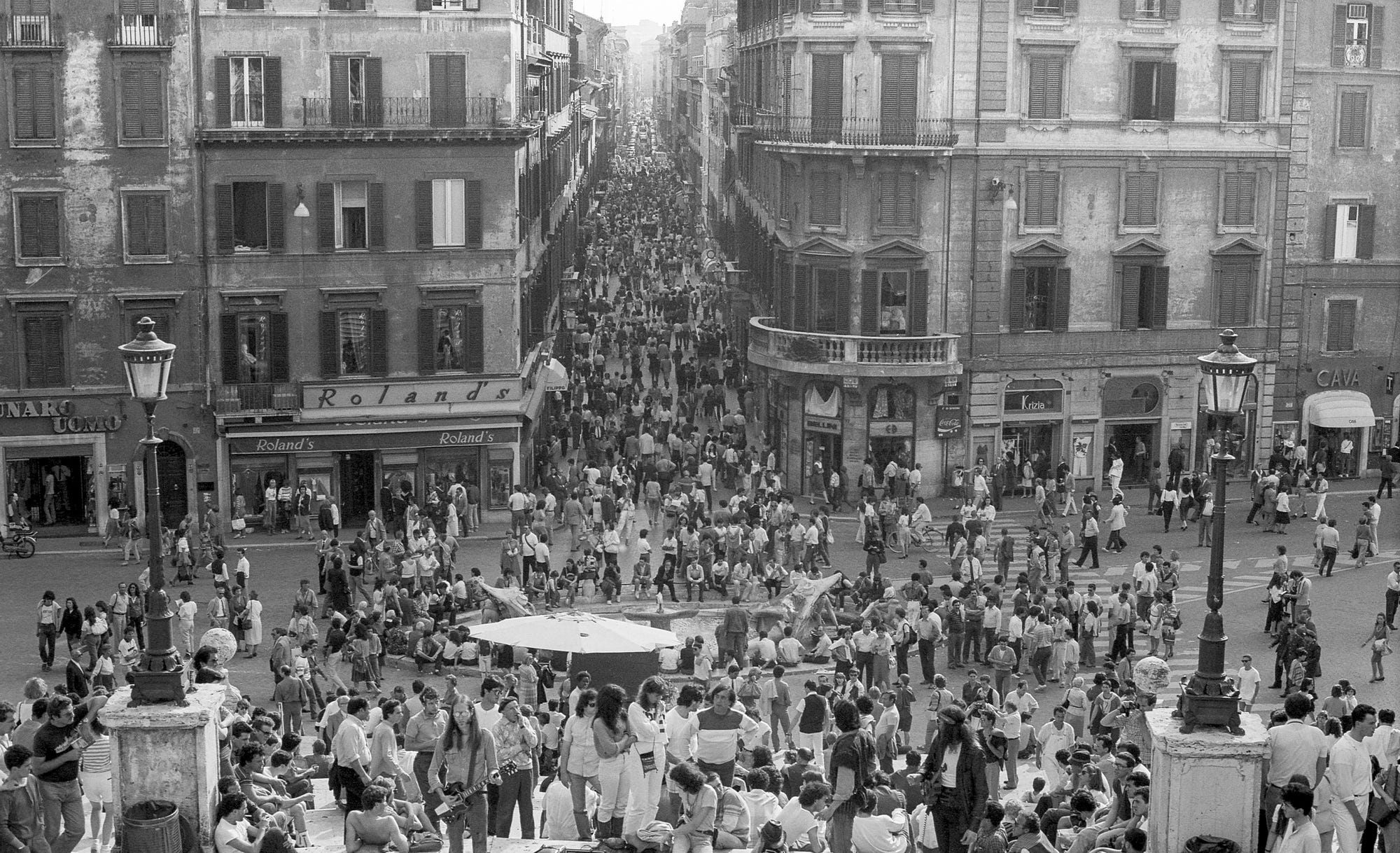
Being both a student and a tourist, of course I had to climb the ‘Spanish steps’ (Scalinata di Trinità dei Monti) and found myself in a very mixed crowd of Italians and tourists, when a hippie band (who were intentionally looking out of style probably) started playing some psychedelic 70’ish music. In those days sitting on the steps and street musicians without a permit were still allowed. Looking at this photo in a bigger size enabled me to really take the time to look at all the different faces and the shops, now all vanished or at least changed drastically. I have been standing here for quite a while, taking everything in and enjoying the view into the via dei Condotti. The photo just shows the widest possible view, to capture the overwhelming presence of all these people. A point of view higher up the stairs would have resulted in a composition with more distractions and less details.
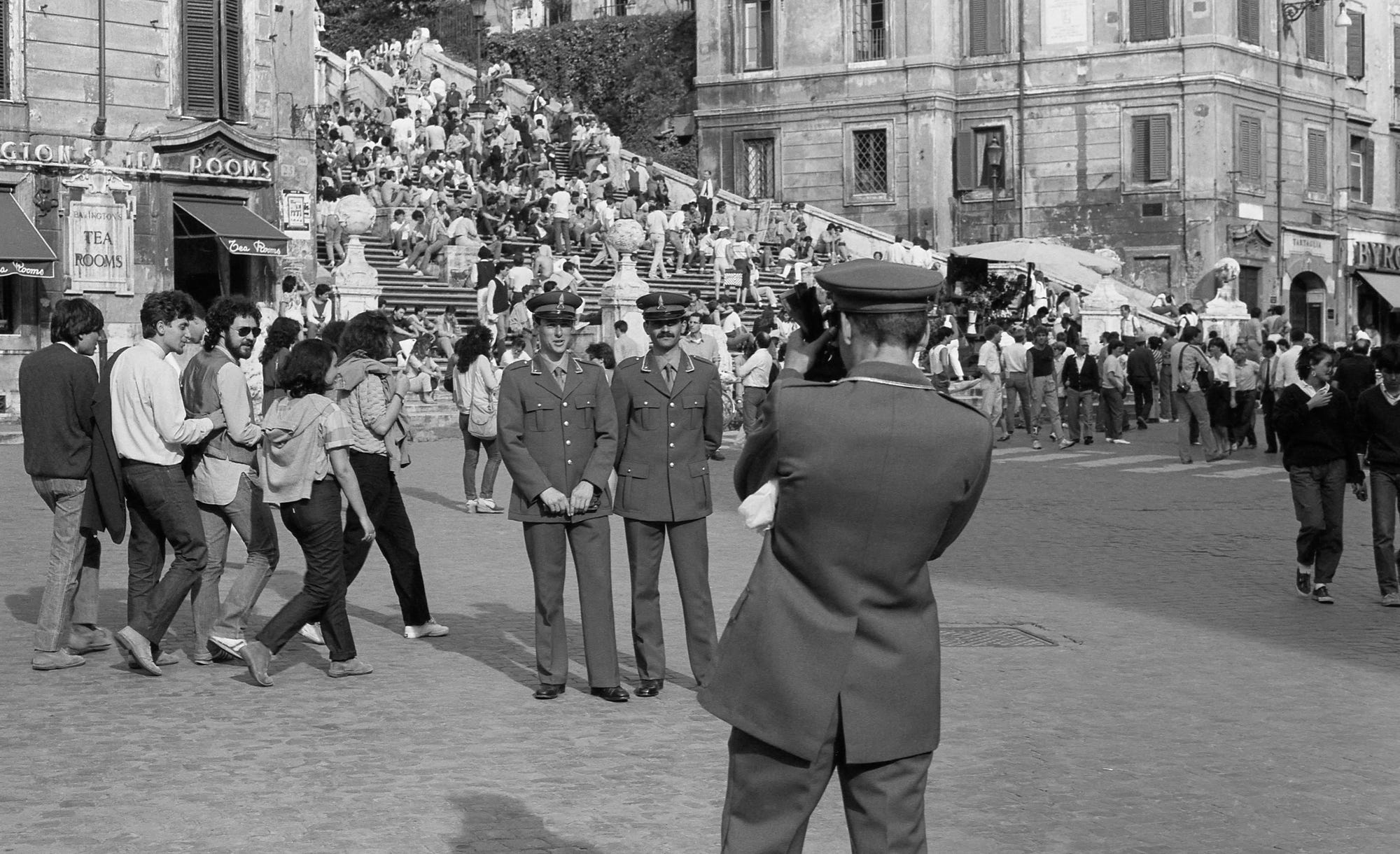
At the base of the Spanish steps, on the piazza di Spagna, I looked over the shoulder of an officer of some kind who was taking a picture of two of his friends/colleagues in front of the steps, while a group of young and trendy Romans passed in lockstep. One of them seemed to have his thoughts about the uniformed men. I vividly remember this scene. I like this type of shot-in-a-shot, where the photographed stay focused on having their picture taken as a personal memory and you as a photographer can fit their photo-op into your composition as a vignette.
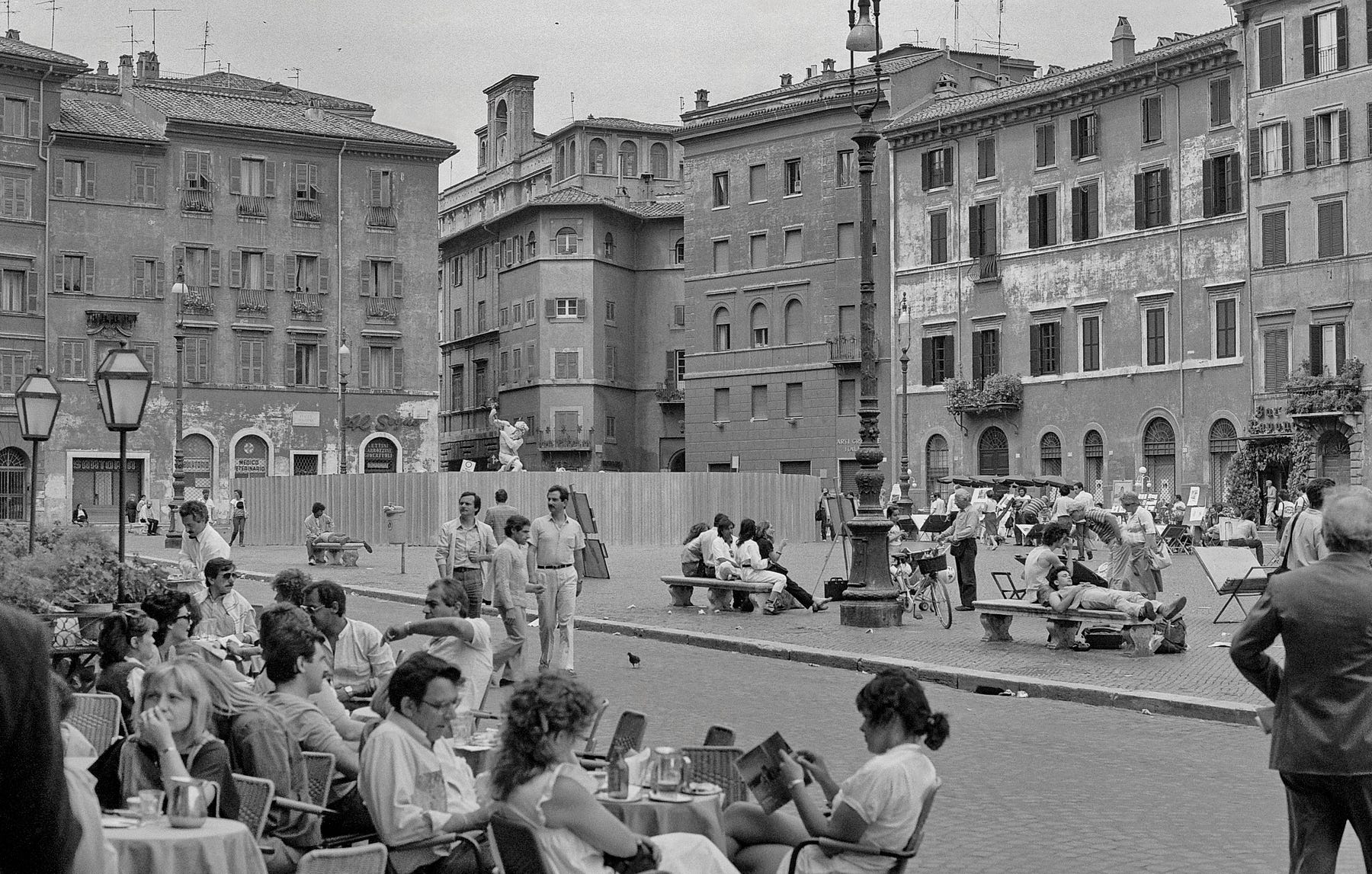
The famous Piazza Navona is usually full of people in June, but on an overcast Sunday morning a visit is obviously less attractive, which for me meant having the pavement line available as a compositional element. Less fortunate was the ongoing restoration of the beautiful fontana del Moro (by della Porta), shielded by an ugly fence, which I make a little less conspicuous by fitting it into the composition as horizontally as possible, As you can see, that didn’t really work. The interaction between people (and the breathtaking Baroque beauty of the piazza) instantly made me choose this view.
The Roman writer/poet Virgil was spot-on when he called Rome ‘eternal’. There is most definitely a vibe of continuity, a never-ending quality about it. Did you notice the total absence of people holding telephones in these photos? I wonder what kind of experience revisiting Rome would be and if I should even consider that at all.
All images were shot with an Olympus OM 10 with a Zuiko 50 mm 1.8 lens on Agfapan, Ilford and Kodak negative film. I really enjoyed this camera/lens-combo, it was what I needed: a straightforward, easy-to-focus semi-automatic SLR with a well-built and sharp standard lens, with a lot of character.
I hope you have enjoyed this. I’d like to hear from you if you’ve visited Rome recently or live there, what differences you see with these photos made 41 years ago. Of course, any other comment is welcome too.
That decade was special to me and I was also in Rome then — when it snowed. All negatives destroyed in a flood last year:( so I can't share any with you. Thanks for taking us with you.
I have so much I can write about these photos. First of all: They are amazing. Especially the ones from Piazza di Spagna. Not only do they show a truly beautiful part of Rome which unfortunately no longer exists in the same way for many reasons. As you mention you are no longer allowed to sit on the Spanish Steps. It has been turned into yet another boring monument, which you can only walk on. I remember sitting there as a teen and in my twenties together with friends, drinking wine and chatting with boys. Now it is all white and clean and polished with no life. The first photo in your post also means a lot to me. For three years I worked at the end of that street - Via Omero - at the Danish Institute, so I have walked past the Dutch Institute many times coming from Villa Borghese and going to work. When I saw your photo with the two carabinieri I recognized the shop sign where it says Da Paola, but I couldn’t remember where I had seen it. Then I read the post and realized, that it was the Pantheon in the back. For one year I lived as an au pair in Via del Seminario right next to Piazza della Rotonda (back in 1994), so of course I must have seen that shop many times. Rome holds a very special place in my heart. I have lived there many times and for a total of more than ten years. However I have only been back for shorter stays since I left it for Florence in 2011, and I must say that it seems to me, it has changed a lot and not for the better. Your post was truly a wonderful trip to my past and the photos are beautiful.